How to calculate GPA
Your GPA calculator result is a credit-weighted average of your grades. Each course counts in proportion to its credit hours, so a 4-credit science course affects GPA more than a 1-credit seminar. This page uses a standard 4.0 scale for GPA, which is the scale most students expect when they search for a college GPA calculator or a GPA calculator high school tool.
Semrush shows that gpa calculator is the dominant topic, with related searches such as college GPA calculator, how to calculate GPA, GPA calculator college, GPA calculator high school, and GPA converter to 4.0. They all point to the same core task: convert course grades into grade points, account for credit hours, and return a GPA that is easy to understand.
To calculate GPA, convert each letter grade into grade points, multiply by the course credit hours, add the quality points, and divide by total credit hours. The calculator does that math live as you enter courses.
What GPA measures
GPA stands for grade point average. A course with more credit hours has more influence than a smaller course because it represents more academic work. For example, an A in a 4-credit science course contributes more to your GPA than an A in a 1-credit seminar.
Most U.S. colleges and high schools that use a 4.0 scale assign 4.0 points to an A, around 3.0 points to a B, around 2.0 points to a C, and 0.0 points to an F. Some schools use plus and minus grades, while others use only whole letters. This calculator includes common plus/minus values so you can estimate your GPA quickly.
A useful scale for GPA should match your school as closely as possible. This calculator is designed for standard unweighted GPA on a 4.0 scale, so it is best for quick planning, semester estimates, and understanding how grade points and credit hours combine.
GPA calculator formula
GPA = Σ ( Grade Points × Credits ) ÷ Σ ( Credits )
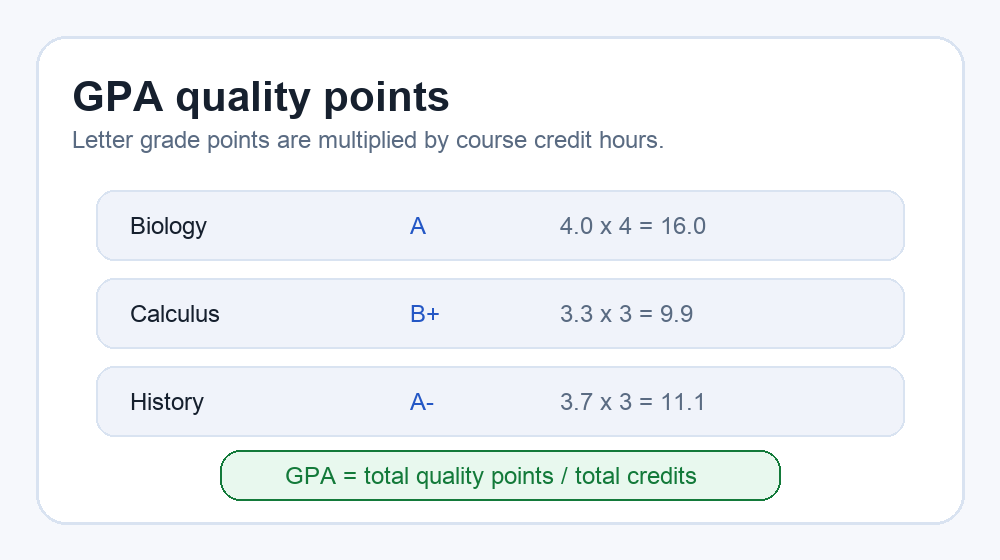
Many schools call grade points multiplied by credit hours quality points. If Biology is an A in a 4-credit course, it contributes 4.0 × 4 = 16 quality points. If Calculus is a B+ in a 3-credit course, it contributes 3.3 × 3 = 9.9 quality points. Add all quality points, then divide by total credit hours.
This is the direct answer to how do you calculate GPA: every course creates quality points, and GPA is total quality points divided by total credit hours. If you are asking how can I calculate my GPA before grades are official, use estimated letter grades and update them when your final grades are posted. If a course is still waiting on its final exam, the final grade calculator shows the exam score you need before that letter grade is locked in.
Grade point scale (4.0)
A/A+ = 4.0 · A− = 3.7 · B+ = 3.3 · B = 3.0 · B− = 2.7 · C+ = 2.3 · C = 2.0 · C− = 1.7 · D+ = 1.3 · D = 1.0 · D− = 0.7 · F = 0.0
Use the scale that matches your school when possible. Some schools count A+ as 4.3, some cap A+ at 4.0, and some calculate weighted GPA differently for honors, AP, IB, or dual-enrollment courses. This calculator uses a standard unweighted 4.0 scale so the result is easy to compare and understand.
If you need a GPA converter to 4.0, first map your school's letter or percentage grade to the closest grade point value. For example, an A usually converts to 4.0, a B to 3.0, and a C to 2.0 on an unweighted scale. Exact conversion tables can vary, so official transcripts should always come from your school.
Example
Biology A (4 credits), Calculus B+ (3 credits), History A− (3 credits).
GPA = (4.0×4 + 3.3×3 + 3.7×3) ÷ (4+3+3) = 37.0 ÷ 10 = 3.70.
Semester GPA vs. cumulative GPA
To calculate a semester GPA, enter only the courses from one semester or term. To estimate a cumulative GPA, include all courses that should count toward the cumulative result. If you already know your previous cumulative GPA and credits, you can include them as one row by converting them into an equivalent course: use your previous GPA as the grade point value conceptually and your previous credits as the credit weight. Because this page accepts letter grades, the simpler approach is to enter all individual courses when you have them.
For official records, always use your school's transcript or registrar calculation. Institutions may exclude repeated courses, transfer credits, pass/fail classes, withdrawals, or non-degree coursework in ways a general GPA calculator cannot automatically know.
College GPA calculator vs. high school GPA calculator
A college GPA calculator usually depends on credit hours because a 4-credit course carries more academic weight than a 1-credit course. That is why this calculator asks for credits on every row. It works well for college GPA calculator use cases when your transcript lists letter grades and course credits. If you first need a course's percentage from homework, exams, and projects, the weighted grade calculator builds that course grade for you.
A GPA calculator high school use case can be different. Many high schools use equal course weights, while others use weighted GPA for honors, AP, IB, or dual-enrollment classes. This page is best for unweighted high school GPA on a standard 4.0 scale. If your school adds extra points for advanced classes, treat this as an estimate and compare it with your school's official policy.
What to enter for credit hours
Credit hours are usually listed in your course schedule or transcript. Common values are 1, 2, 3, and 4 credits. Labs, seminars, and physical education courses may have fewer credits, while science or language courses may carry more. If all courses have the same credit value, the GPA becomes close to a simple average of grade points. If credits differ, the higher-credit courses carry more weight.
If you are asking how to calculate your GPA for a single term, enter only that term's courses. If you are estimating a cumulative GPA, enter every course that should count or use your school's official cumulative GPA once it is available.
Common GPA calculation mistakes
- Forgetting to multiply grade points by credit hours before averaging.
- Using a weighted high school GPA scale when the calculator is set up for an unweighted 4.0 scale.
- Including pass/fail classes that your school does not count toward GPA.
- Counting repeated courses incorrectly when your school replaces the old grade or averages both attempts.
- Mixing quarter credits and semester credits without converting them consistently.
How to improve your GPA
Your GPA changes fastest when you improve grades in high-credit courses because those courses create more quality points. If you are planning the next semester, compare possible grades and credit hours before choosing where to focus effort. A one-letter improvement in a 4-credit course can affect your GPA more than the same improvement in a 1-credit course.
If your goal is a scholarship, honors cutoff, athletic eligibility threshold, or graduate school requirement, use this calculator to model realistic semester outcomes. Try different letter grades for your current courses and watch how the GPA changes.
This page can also support final GPA calculator planning when you want to estimate how current courses may change your GPA at the end of the term. It does not replace registrar rules, but it can show which credit-heavy classes have the biggest effect.
Frequently asked questions
How to calculate GPA?
Convert each letter grade to grade points, multiply those points by the course credit hours, add the quality points together, then divide by the total credit hours.
How do you calculate GPA from letter grades?
Use the grade point value for each letter grade, such as A = 4.0, B = 3.0, and C = 2.0 on a standard 4.0 scale. Multiply by credits, add the totals, and divide by total credits.
How to calculate your GPA for college?
Enter each college course, its letter grade, and its credit hours. The calculator returns a credit-weighted GPA for the courses you entered.
Can this work as a GPA calculator for high school?
Yes, for unweighted high school GPA on a standard 4.0 scale. Weighted GPA rules for honors, AP, IB, or local school policies can vary.
What is a good GPA?
3.0 is a solid B average, 3.5+ is strong, and 3.7+ is excellent. Many scholarships look for 3.5 or above.
What are quality points?
Quality points are grade points multiplied by credit hours. GPA is total quality points divided by total credit hours.
Can I calculate cumulative GPA?
Yes, if you enter all courses that should count toward the cumulative GPA. For official cumulative GPA rules, check your transcript or registrar policy.
Does this support weighted GPA?
This calculator uses a standard unweighted 4.0 scale. Weighted GPA rules vary by school, especially for honors, AP, IB, and advanced courses.
Is this GPA calculator free?
Yes. It is free, requires no account, and runs in your browser.